
Tree Removal Services Near Me: What You Should Expect Start to Finish
Most people searching for tree removal services near me have never had a tree removed before.
A tree removal isn’t a small thing; it involves equipment, a trained crew, real risk, and a property you’ve spent years maintaining. Knowing what the process looks like from the first phone call to final cleanup takes the uncertainty out of it.
This is what actually happens on a professional tree removal in Geneseo and the surrounding Livingston County area, broken down so you know what to expect at every stage.
How Crews Assess Risk Before Cutting Begins
Nothing happens before the assessment. That’s the part most homeowners don’t see, but it’s where the whole job gets planned.
A qualified arborist walks the tree before anyone picks up a saw. Species, structural condition, lean direction, root plate stability, and proximity to structures, utility lines, and other landscape features all get evaluated. On a Geneseo property, that often means accounting for older trees with decades of growth and clay-influenced soil conditions that affect how a root system anchors.
What they’re looking for: visible decay, co-dominant stem unions that could split unpredictably, root damage from construction or soil compaction, cavities in the lower trunk, and any lean that indicates where the tree wants to fall versus where it needs to fall. The tree’s condition tells the crew which removal method is appropriate, whether it can be felled in a controlled direction, needs to be climbed and sectioned from the top down, or requires crane assistance.
The assessment also covers ground conditions. Soft soil after rain affects how equipment can be positioned. Frozen ground in winter changes how debris gets managed. A crew that skips this step and starts cutting is the one you don’t want on your property.
What Happens on the Day of Removal Hour by Hour
The crew arrives and establishes a work zone before any cutting starts. Cones, flagging, or rope lines go up around the drop zone and equipment staging area. If you have vehicles, outdoor furniture, or anything near the work area, they should be moved before the crew arrives; most companies will tell you this when the job is booked.
The first hour is setup. Equipment gets positioned, escape routes get identified, and the removal sequence gets confirmed between the ground crew and the climber or operator. On a straightforward removal with a clear drop zone, this goes quickly. On a tighter job, a tree between a fence, a garage, and a power line, the setup takes longer because every variable needs to be accounted for before the first cut.
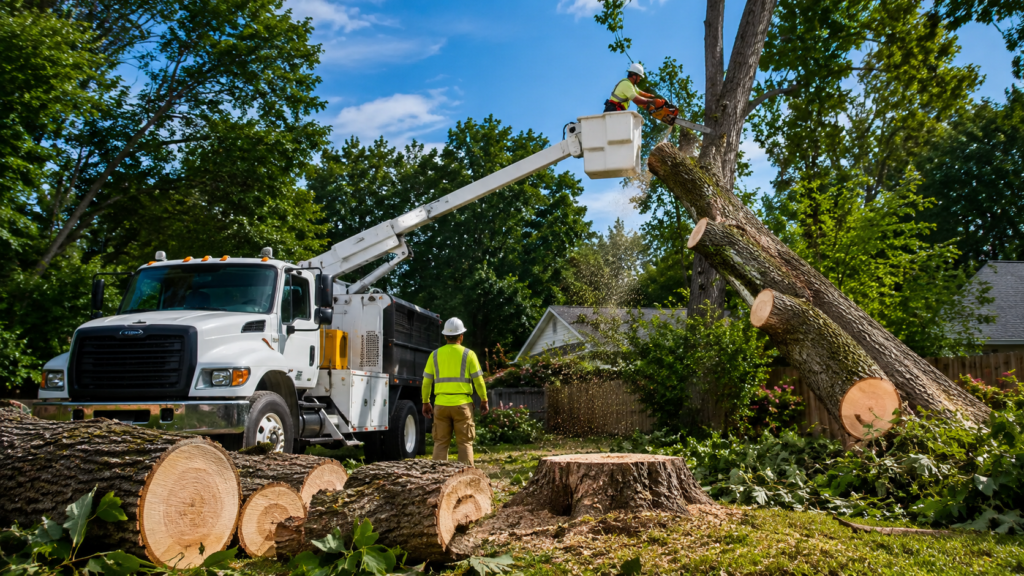
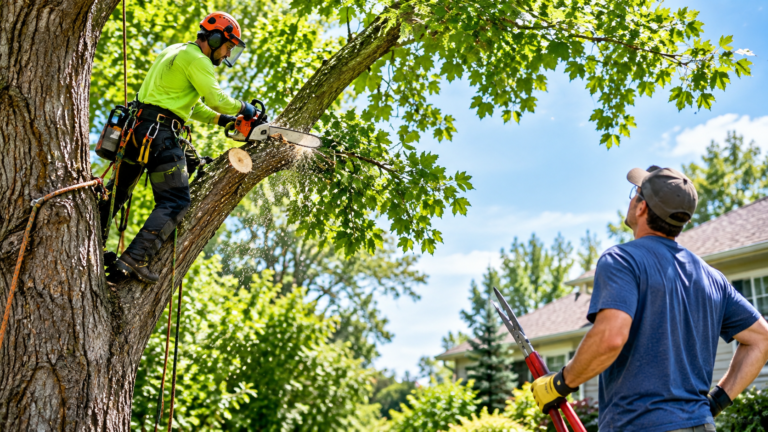
Cutting begins from the top on complex removals. The climber works down in sections, each piece lowered on a rope to the ground crew rather than dropped. On open-lot removals with sufficient clearance, a notch-and-back-cut fell brings the whole tree down in a controlled direction. Either way, the process is methodical. The crew isn’t in a hurry because rushing a tree removal is how properties get damaged.
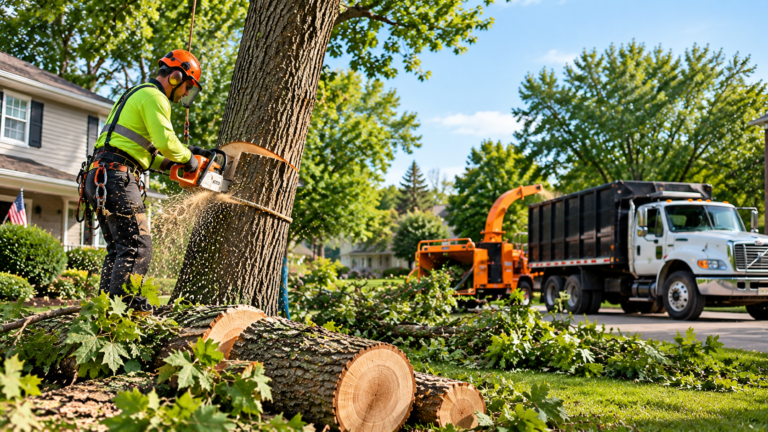
Debris management runs alongside the removal. Ground crew feeds brush into the chipper continuously rather than letting it pile up, which keeps the work zone clear and makes the final cleanup faster. Log sections get moved to a staging area as they come down.
By the time the last section hits the ground, the site cleanup is already mostly done. A final pass with rakes and a blower handles the small material. Most residential tree removal near me jobs in the Geneseo area wrap in a single day. Larger or more complex removals may run into a second morning for final cleanup.
Equipment Used and Why It Matters
A chipper handles brush and small-diameter wood and is standard on every professional removal. The size of the chipper matters; an undersized unit on a large removal creates a debris management bottleneck that slows the whole job. A climbing setup with proper rigging lines, friction devices, and rated hardware is what separates controlled sectional removal from dropping pieces and hoping for the best.
For tight situations, a large tree close to a structure with no clean rigging angle, a crane removes the variable that ground-based rigging can’t fully control. The crane lifts sections straight up and out, placing them in a clear area away from everything that can’t be hit. It’s not always necessary, but when it is, it’s the right tool.
Stump grinders come in different sizes for a reason. A walk-behind unit handles accessible residential stumps efficiently. A larger tracked unit reaches stumps in areas where a smaller machine can’t get enough power or leverage. When you’re looking for affordable tree removal near me, clarify whether stump grinding is included or quoted separately, it often isn’t, and it’s worth knowing upfront.
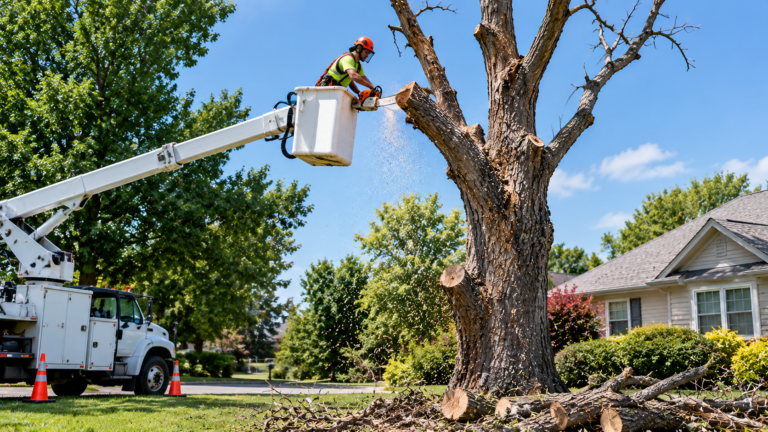
Bucket trucks give aerial access on jobs where climbing isn’t practical, typically dead or structurally compromised trees where putting a climber in the canopy introduces unnecessary risk. On an EAB-affected ash tree in Livingston County, a bucket truck keeps the crew out of unpredictable wood while still allowing controlled sectional removal.
Debris Removal and Site Cleanup Explained
Cleanup is part of the job. Not an add-on. Not something you negotiate after the tree is down.
A professional tree service company near me leaves the property the way it looked before they arrived, minus the tree. Brush gets chipped. Log sections get stacked, removed, or split depending on what you’ve arranged in advance. Sawdust and wood chips from the stump grinder get raked smooth. Any equipment damage to lawn or bed edges gets addressed before the crew loads out.
Ask about this specifically when you book. Some companies include full debris removal in the base quote. Others haul away brush but leave log sections for you to handle. Knowing which applies to your job prevents a conversation you don’t want to have after the work is done.
Galbraith Tree & Shrub includes debris removal and site cleanup as standard on every Geneseo-area removal. The property gets walked before the crew leaves, and any remaining material gets addressed before equipment is loaded.
What to Do With Your Removed Tree’s Wood
Firewood is the most common use. Hardwood species, oak, ash, maple, black cherry, split well and burn clean once they’ve had a full season to dry. Ask the crew to cut sections to firewood length before they’re staged if this is your plan. Green wood needs six to twelve months of drying before it’s ready to burn efficiently.
Milling is worth considering for high-quality hardwoods. A large black walnut or white oak removed from a Geneseo property can yield usable lumber for furniture, shelving, or flooring. Local sawyers in Livingston County will sometimes take logs on a share basis if the wood is sound. Ask the arborist during the assessment whether the wood has mill value.
For species that aren’t worth milling or splitting, hollow trees, heavily decayed wood, or invasive species, chipping is the practical answer. Wood chip mulch from the removal can be used directly in beds if you want it. Most crews are happy to leave a pile rather than haul it if you give them a spot.
Post-Removal: Stump Options and Lawn Care Tips
The stump is a separate decision, and it’s worth thinking through before the removal day.
Grinding is the standard approach. A stump grinder reduces the stump to wood chips six to twelve inches below grade, which is deep enough to allow turf or bed plantings over the top. The remaining chips decompose over a few seasons. Grinding doesn’t remove the lateral roots, but it eliminates the visible stump and the regrowth that would otherwise come from it.
Full extraction removes the root ball entirely. It’s more disruptive to the surrounding area and costs more, but it’s the right choice if you’re planning construction, a patio, or any hardscape in that area. Grinding leaves root mass underground that can complicate future digging.
After grinding, fill the depression with a mix of topsoil and compost, level it with the surrounding grade, and seed with a turf blend appropriate for Livingston County conditions. Keep it watered through the first growing season. By the following year, the area typically fills in completely.
If you’re not grinding, cut the stump as low to the ground as possible and apply a stump treatment to slow regrowth. Without intervention, most hardwood stumps will send up sprouts from the root system for several seasons.
How to Book Same-Day Tree Removal in Geneseo
Same-day availability depends on crew schedule and the nature of the job.
Emergency situations, such as a fallen tree on a structure, an active hazard over a high-traffic area, or a tree that came down in a storm, are prioritized. Tree removal Geneseo emergencies typically reach a crew faster than non-emergency removals because most professional companies maintain some availability for active hazard calls.
For standard removals, call as early in the day as possible if you’re hoping for same-day service. Have your information ready: species if you know it, approximate size, location on the property, and anything around it that affects access or drop zone.
Galbraith Tree & Shrub serves Geneseo and surrounding Livingston County with same-day emergency response and scheduled removal services. The more information you can provide on the call, the more accurately the crew can be prepared before they arrive.
When you’re ready to book tree cutting near me in the Geneseo area, the process starts with a call and a straight conversation about what you have and what needs to happen. Galbraith Tree & Shrub gives you an honest assessment and a written quote before any work begins.
Frequently Asked Questions
How long does a typical tree removal take in Geneseo?
Most residential removals in the Geneseo area take half a day to a full day, depending on tree size, location, and site conditions. Larger trees, tighter lots, or crane-assisted removals may extend into a second morning for final cleanup and debris removal.
Do I need to be home during the tree removal?
Not necessarily, but it helps for the initial walkthrough and final site check. If you can’t be present the entire time, make sure access is arranged, any vehicles or obstacles are moved, and someone is reachable by phone in case questions come up during the job.
What’s the difference between tree removal and tree trimming?
Removal takes the entire tree down to the stump level. Trimming addresses specific branches to improve structure, clearance, or health while leaving the tree standing. An arborist assessment determines which option applies; some trees that look like removal candidates only need structural pruning.
Is stump grinding included in the tree removal cost?
Not always. Many companies quote removal and stump grinding separately. Clarify this when you book so there are no surprises after the tree is down. Grinding typically adds a few hundred dollars depending on stump diameter and access conditions on your property.
How do I know if a tree removal is an emergency situation?
A tree on a structure, a hanging limb over an occupied area, a tree that’s visibly leaning after a storm, or any situation that creates an immediate safety risk qualifies as an emergency. Call the same day. Don’t wait to see if it stabilizes, compromised trees don’t get safer on their own.
Most residential removals in the Geneseo area take half a day to a full day, depending on tree size, location, and site conditions. Larger trees, tighter lots, or crane-assisted removals may extend into a second morning for final cleanup and debris removal.
Not necessarily, but it helps for the initial walkthrough and final site check. If you can’t be present the entire time, make sure access is arranged, any vehicles or obstacles are moved, and someone is reachable by phone in case questions come up during the job.
Removal takes the entire tree down to the stump level. Trimming addresses specific branches to improve structure, clearance, or health while leaving the tree standing. An arborist assessment determines which option applies; some trees that look like removal candidates only need structural pruning.
Not always. Many companies quote removal and stump grinding separately. Clarify this when you book so there are no surprises after the tree is down. Grinding typically adds a few hundred dollars depending on stump diameter and access conditions on your property.
A tree on a structure, a hanging limb over an occupied area, a tree that’s visibly leaning after a storm, or any situation that creates an immediate safety risk qualifies as an emergency. Call the same day. Don’t wait to see if it stabilizes, compromised trees don’t get safer on their own.
Keep Reading
More from the blog
Practical guidance on looking after the trees on your property.
Dead Tree Removal Geneseo: When to Remove & Safety Risks
A dead tree rarely announces itself. One summer the maple by the driveway leafs out late, the next it doesn’t leaf out…
Affordable Tree Removal Near Me: Budget Options Without Compromising Safety
When a tree becomes damaged, diseased, unstable, or simply outgrows its space, removing it may be necessary to protect your property. However,…
Tree Trimming Company Guide: Certified Arborists vs DIY (Why It Matters)
A branch hangs over your roof, and you wonder if you can handle it yourself. Maybe you can. Plenty of trimming is…