Commercial Tree Service: Protecting Business Properties & Liability
A tree on a business lot looks like scenery until it isn’t. A limb drops onto a delivery van. A root pushes up a walkway slab. A customer trips and the phone starts ringing. At Galbraith Tree & Shrub, we work on trees around Livingston County every week, and the calls that worry us most come from owners who never had a plan.
This post explains how commercial tree service works, what it protects, and what to ask before you hire anyone. It’s written for owners and property managers in and around Geneseo who want straight answers.
Why Commercial Properties Need Professional Tree Care
Trees on a business property are not the same as trees in a backyard. People walk under them, park beside them, and drive past them all day. If one fails, the damage is rarely limited to the tree.
A homeowner can wait a season on a questionable branch. A business can’t, because the people on the lot are customers, employees, and visitors, and the owner answers for their safety. That is the main reason commercial tree service exists as its own line of work. The jobs are bigger, the traffic is heavier, and the paperwork matters.
A good commercial arborist looks at a tree the way an inspector looks at a roof. The question is not whether it looks nice today. The question is what it will do in the next ice storm, and who is standing under it when it does.
Common Tree Hazards That Threaten Business Properties
Most hazards give some warning. Deadwood in the crown is the obvious one, and it comes down in ordinary wind. Cracks in the trunk, large splits where two stems join, and mushrooms or conks at the base all point to decay inside. Roots that heave pavement or sit too close to a foundation cause slower trouble that gets expensive over the years.
Around Geneseo, we see a few repeat problems. Ash trees killed by emerald ash borer stay brittle and can fail without much notice. Silver maples grow fast and tend to shed large limbs. Trees planted too close to a building or a utility line were often fine when planted and are now a problem. Our heavy, wet lake-effect snow and the occasional ice storm add weight to every branch, and weak wood loses that contest.
Parking lots add their own stress. Compacted soil, salt in winter, and roots cut during repaving all shorten a tree’s life. A tree that has been quietly declining for years often looks fine from the road.
Commercial Tree Inspection: Identifying Risks Before They Cause Damage
An inspection starts on the ground. We walk the property, look at each tree from several sides, and check the base, the trunk, the union points, and the canopy. We note what stands near it, because a weak tree over an empty field is a different case than one over an entrance.
Some trees need a closer look. If a tree has a lean, a cavity, or fungal growth, a certified arborist may recommend further testing. ISA Certified Arborists are trained to assess tree condition, and many follow the risk assessment methods published by the International Society of Arboriculture. The goal is a written record of what was found and what was recommended.
That record matters more than most owners expect. A dated report shows that you looked at your trees and acted on what you learned. It also gives you a clear list to budget against, instead of a surprise after the next storm.
Preventive Tree Maintenance for Business Properties
Prevention is cheaper than cleanup, and it’s usually quieter too. Regular tree maintenance services include pruning out dead and crossing branches, raising the canopy over drives and walkways, and thinning where limbs rub against each other. Younger trees benefit from structural pruning, which shapes them so they hold together better as they grow.
Soil care counts as well. Mulch kept off the trunk, protection for roots during construction, and watering during dry summers all help trees handle stress. Lots that get heavy road salt in winter may need extra attention to the trees nearest the pavement.
Pruning cuts matter. Topping a tree, which means cutting large limbs back to stubs, may look tidy but it leaves weak regrowth that breaks more easily. Proper pruning follows industry practice, with cuts made at the right spot so the tree can seal the wound. If a contractor suggests topping, that’s worth questioning.
Tree Removal and Trimming Around Parking Lots, Buildings & Walkways
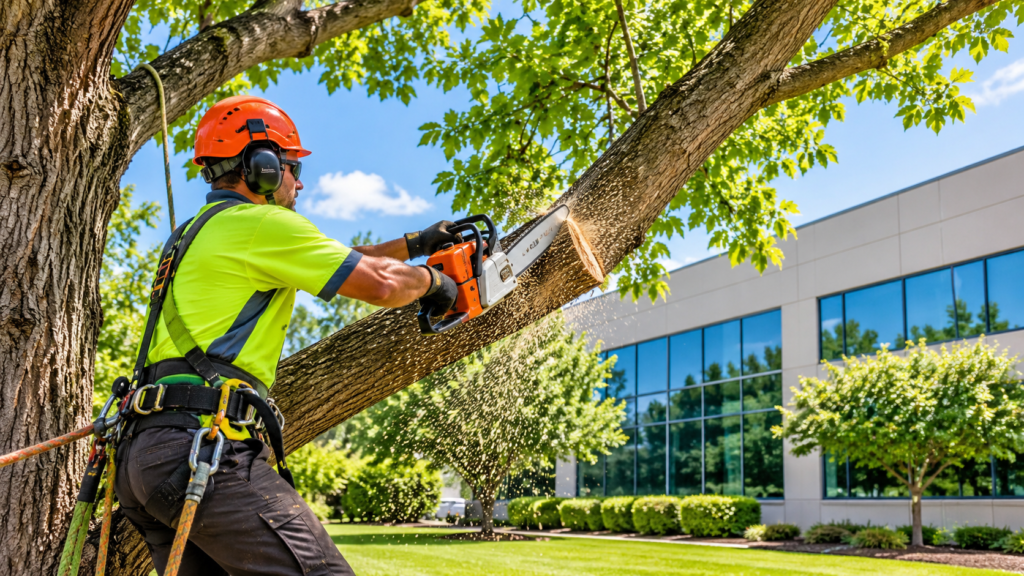
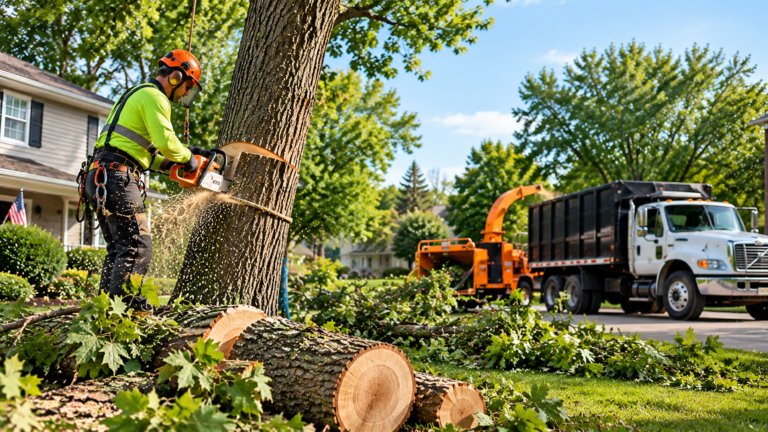
Work near people and property takes planning. Before a crew starts, we look at where the tree can fall or be lowered, where cars and pedestrians will be, and what lines or structures are nearby. Often the safest method is to take a tree down in sections, roping each piece and lowering it under control instead of dropping it.
Business lot tree removal usually means working around something. That might be a storefront, a drainage grate, or a sign. Crews coordinate with the owner to close off parking spaces and walkways for the day, and customers are routed around the work area. Done well, a business stays open for most of it.
Trimming has a purpose beyond looks. Branches that hang over a roof drop debris into gutters and can damage shingles. Limbs close to a building give squirrels a path to the attic. Branches blocking a sign, a camera, or a light create safety and security gaps. Keeping a clear zone around those spots is simple maintenance that avoids bigger repairs.
Not every tree should be cut down. Sometimes a good pruning and a follow-up inspection are enough. When a tree is declining, hollow, or leaning toward a structure, removal is the safer answer, and we’d rather tell an owner that plainly than sell a trim that won’t fix anything.
Storm Damage and Emergency Tree Services for Businesses
When a storm hits, the first priority is safety. Stay clear of downed limbs, and treat any tree touching a power line as live until the utility says otherwise. Call the utility first for lines. Then call a tree crew for the wood.
A tree on a roof or blocking an entrance needs fast, careful work. Wood under tension can spring when it’s cut, and a limb hanging in another tree can drop without warning. This is skilled work, not a job for a rented saw and a few employees.
Emergency calls go smoother when you already have a relationship with a company. A crew that knows your property can find the shutoffs, the access points, and the trouble spots faster. Take photos of any damage before cleanup starts, because your insurer will want them.
Tree-Related Liability: What Property Owners and Managers Should Know
This is the part owners ask about most, so here it is in plain terms. In general, a property owner has a duty to keep the premises reasonably safe. If a tree failed and the owner knew, or should have known, it was a hazard, that can raise real questions about responsibility. A tree that fell with no warning during a severe storm is usually treated differently. Rules vary, so a local attorney or your insurance agent has the final word.
Insurance is where owners get caught. Many commercial property policies cover tree debris removal only when the tree damaged a covered structure or blocked access, and often with a dollar limit. They typically don’t pay to remove a dead tree that simply stands there. Review your liability coverage with your agent before a storm, not after one.
Your contractor’s coverage matters too. If a worker is hurt or a vehicle is damaged on your lot, you want the contractor’s insurance responding, not yours. Ask for a certificate of insurance, and ask for it to be sent to you directly from the insurer or agent. The certificate should show general liability and workers’ compensation.
How Professional Tree Care Helps Prevent Property Damage and Accidents
Most tree accidents on business lots trace back to something that was visible earlier. A dead limb was noticed and not addressed. A cracked trunk was left alone for years. A root problem was patched instead of looked at.
Regular commercial tree service turns those quiet warnings into a scheduled task. The crew finds the problem, you decide what to do, and the work happens on a day you pick. That is easier on staff, easier on customers, and usually easier on the budget than reacting after a failure.
Trees also add value when they’re healthy. Shade cools a lot, curb appeal draws people in, and mature trees are hard to replace. The aim is not to remove trees. It’s to keep the good ones standing safely.
Choosing the Right Commercial Tree Service Company
Start with credentials. Ask whether an ISA Certified Arborist is on staff or supervising the work. Ask for proof of liability and workers’ compensation coverage. Then ask for references from other business properties, not just homeowners.
Look at how a company explains the job. A solid estimate is written, names the trees involved, and says how debris and stump work will be handled. Be careful with anyone who pushes you to decide on the spot, offers a price far below the others, or recommends topping.
Local knowledge counts. A company that works in commercial tree service Geneseo NY knows the soils, the common species, the village rules on right-of-way trees, and how our winters behave. You can check a company’s Google Business Profile, read recent reviews, and confirm the address and phone number match what they tell you. A real local shop should have a track record you can see.
How Often Should Commercial Properties Schedule Tree Maintenance?
For most business properties, a yearly walk-through by a commercial arborist is a sensible baseline. Add another look after any major storm. Mature trees, trees near buildings, and trees over high-traffic areas may warrant closer attention.
Pruning cycles depend on species and age. Young trees often benefit from light pruning every few years, while mature trees may need it less often. Your arborist can set a schedule based on what’s actually growing on your lot.
At Galbraith Tree & Shrub, we’d rather help you plan a modest schedule than field an emergency call at midnight. A plan on paper, even a simple one, puts you ahead of most properties we visit.
Frequently Asked Questions
How much does commercial tree service cost?
It depends on tree size, height, access, equipment needed, and hazards nearby, like power lines or buildings. Large or complicated jobs cost more than simple pruning. A written estimate after an on-site visit is the only reliable way to get a real number.
Who is responsible if a tree on commercial property falls and causes damage?
Usually the property owner is the first party questioned, especially if the tree showed warning signs. Storm events can change that. Responsibility depends on the facts and local law, so talk with your insurance agent or an attorney.
Does commercial property insurance cover tree removal?
Sometimes. Many policies pay for debris removal when a tree damages a covered building or blocks access, often with a limit. They rarely cover removing a dead tree that hasn’t fallen. Read your policy and ask your agent.
How often should businesses have their trees inspected?
Once a year is a good starting point, with an extra check after severe storms. Older trees, trees over parking or entrances, and trees with known defects may need more frequent attention, as advised by a certified arborist.
Why should businesses hire an insured tree service company?
Tree work carries real risk to people and property. If a worker is hurt or something is damaged, the contractor’s insurance should respond first. Without it, the claim could land on your policy or your own finances.
What is the difference between pruning and removal on a business property?
Pruning removes specific branches to improve safety or health and keeps the tree. Removal takes the whole tree out. Pruning fits trees that are sound overall. Removal makes sense when a tree is dead, badly decayed, or leaning toward a structure.
What should I do right after a tree falls on my business lot?
Keep people away and stay clear of any power lines. Call the utility if lines are involved. Take photos for your insurer, then call a qualified tree company to remove it safely. Avoid cutting it yourself.
Keep Reading
More from the blog
Practical guidance on looking after the trees on your property.
Stump Grinding Services: Process, Cost & Aftercare Explained
A tree comes down, and the work feels finished. Then you look out the window and see the stump sitting there. It…
Dead Tree Removal Geneseo: When to Remove & Safety Risks
A dead tree rarely announces itself. One summer the maple by the driveway leafs out late, the next it doesn’t leaf out…
Affordable Tree Removal Near Me: Budget Options Without Compromising Safety
When a tree becomes damaged, diseased, unstable, or simply outgrows its space, removing it may be necessary to protect your property. However,…