
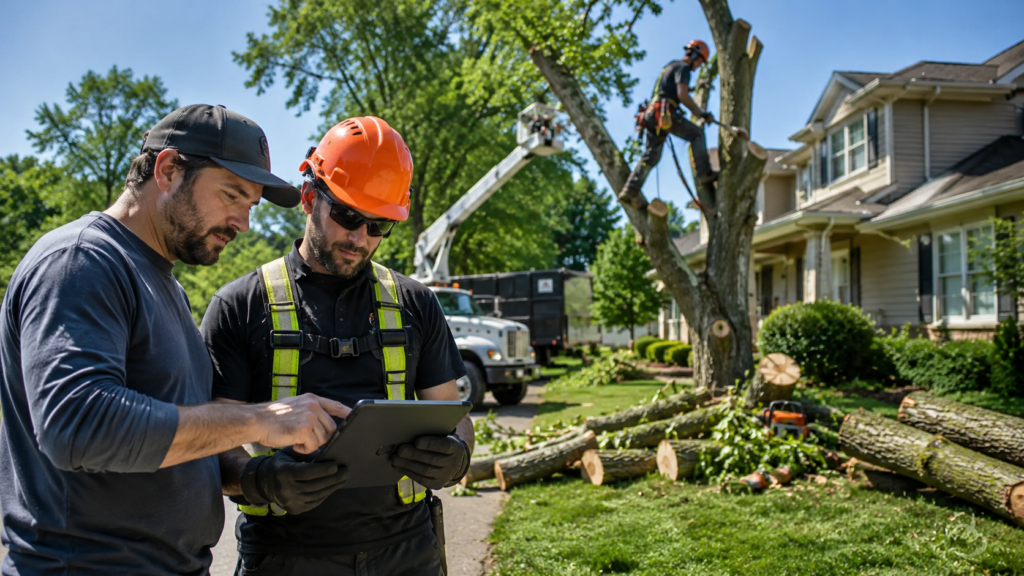
How to Choose the Best Tree Removal Service (Avoid Costly Mistakes)
Hiring the wrong tree removal service costs more than money. It can cost you a damaged roof, a fence in pieces, or a neighbor’s car with a hole in the hood. Most homeowners only deal with major tree removal once every few years, maybe less.
The crew you call doesn’t have that excuse. They do this every week, and either they know what they’re doing, or they don’t, and you usually find out which one after the tree is already on the ground.
This guide walks through what actually matters when you’re looking at tree removal services, what to ask before you sign anything, and how to spot the operators who shouldn’t be anywhere near your property.
Red Flags When Hiring a Tree Removal Company
Some warning signs show up before the crew even arrives.
A truck with no company name on it. No insurance certificate offered up front. A quote that’s way lower than three other bids. A guy who shows up alone for a job that clearly needs a crew of three. Pressure to sign today because “the price won’t last.”
Any one of these alone might mean nothing. Two or three together usually mean something. Furthermore, if a contractor gives you a price without checking where the tree leans, looking up at nearby NYSEG utility lines, or asking what’s underneath it, they probably haven’t removed enough difficult trees.
Contractor Tip: We won’t even quote some removals accurately until we walk entirely around the tree. Dangerous decay often hides on the backside, completely out of view from the driveway.
Walk away from anyone who can’t answer basic questions clearly or rushes the initial walkthrough.
Certifications and Insurance to Always Verify
This is the part people skip, and it’s the part that protects your house.
Ask for proof of general liability insurance and workers’ compensation, not just a verbal “yeah, we’re covered.” Ask if anyone on the crew is a certified arborist, since that credential means someone studied tree biology and rigging physics, not just chainsaw operation. A real company hands you documents without hesitation.
A shaky one stalls, changes the subject, or promises to “email it later.” That email rarely comes.
Insurance matters because trees fall on things. Houses, power lines, cars, the neighbor’s shed. If the crew isn’t insured and something goes wrong, that bill lands on your homeowner’s policy, not theirs. Any certified arborist worth hiring in Geneseo, NY, will carry both and won’t hesitate to show you the paperwork.
Questions to Ask Before Signing Any Contract
A short list, asked out loud, tells you almost everything you need to know:
- What’s explicitly included in the price: Is stump removal, debris hauling, and raking included, or is that extra?
- Property protection: How will you protect my lawn or driveway from heavy equipment, especially during soft spring mud conditions?
- Accountability: Who is responsible if a limb damages a structure during the job?
- Documentation: Is the quote written down with a clear scope, or just a number tossed out verbally?
- Scheduling: What happens if Western New York weather or sudden ice loading pushes the job back?
Get the answers in writing before any work starts.
Why Local Companies Outperform National Chains
National outfits run on volume. Local crews run on reputation, and reputation in a tight-knit community like Geneseo doesn’t survive sloppy work.
A “local tree service company near me” search usually turns up the same handful of names for a reason. They’ve been doing this on the same soil, dealing with the same regional weather patterns for years.
Local expertise matters because of how specific trees behave in Livingston County:
Local expertise is critical in Livingston County due to specific species hazards and tight site constraints. Mature sugar maples present a severe risk of structural failure from internal rot, while EAB-killed ash is highly brittle and unpredictable, requiring specialized rigging for safe extraction.
Additionally, old silver maples are prime candidates for splitting under heavy snow and ice loads. Mitigating these hazards within tight village lots and narrow drop zones between historic homes demands precision, zero-tolerance rigging, and local field experience.
National chains rotate crews and independent contractors from region to region. You might get a sharp team; you might get whoever was available that week.
Choosing local means accountability.
If a local crew does a bad job, the whole town hears about it. That keeps standards higher than a call center two states away ever could. So, ask around town, and you’ll notice the same few names come up when people talk about the best tree service in Geneseo, NY, that has to offer.
Galbraith’s Credentials and Service Guarantees
At Galbraith Tree & Shrub, every removal starts with a thorough on-site assessment. We provide detailed written estimates, carry full liability and workers’ compensation coverage, and have certified arborists available when a tree needs more than just a chainsaw.
We’ve worked on Geneseo properties long enough to know which trees are hidden hazards and which ones just need a preventative trim.
No surprise fees are added after the job is done. This isn’t a sales pitch; it’s the baseline every reputable tree service should meet, and it’s worth verifying no matter who you hire.
Customer Reviews: What Geneseo Homeowners Say
Reviews matter, but you have to read between the lines. Skip the generic five-star reviews that just say “great job, thanks.” Look for the ones that mention specifics: cleanup quality, whether the crew showed up on time, and how they handled a tricky removal near a garage or power line.
Here are a couple of comments we hear most often from homeowners after a job is finished:
“After a summer microburst knocked a huge limb onto our fence, I called Galbraith based on a local recommendation. They showed up quickly, verified their insurance paperwork right on my porch, and had the dangerous wood safely down in hours. It’s hard to find a local team this reliable.”
Sarah L., Livingston County
“I’ve used national chains in the past, but Galbraith outperforms them by a mile. They trimmed three mature maples on my property last fall. Staff took the time to explain which limbs were structural hazards and which just needed a light trim. Fair pricing and honest communication.”
Dave, Genesee Valley
How to Compare Multiple Quotes Fairly
Get at least three quotes before deciding anything, and make sure each quote covers the exact same scope.
One tree removal company might include stump grinding and debris hauling, while another quotes the tree removal alone and adds everything else as a separate line. Comparing those two numbers side by side without checking the fine print is how homeowners end up paying twice the price they expected.
Ask each company to break down labor, equipment, and disposal separately if it isn’t already clear.
The cheapest quote isn’t always the deal it looks like.
A quote that’s far below the others is a major red flag. Either the company is cutting corners on insurance, skipping proper lawn protection mats, or they genuinely underbid the job and will demand more money once the tree is half-cut. Neither outcome works out well for you.
Final Thoughts
Tree removal isn’t a job to hand off to the lowest bidder or the first unmarked truck that pulls into your driveway. The stakes are too high, and the difference between a careful crew and a careless one shows up fast once heavy equipment is on your grass.
Galbraith Tree & Shrub builds its reputation on Geneseo properties one job at a time. For homeowners weighing their options right now, the advice remains the same whether you call us or someone else: verify the insurance paperwork, ensure there’s a certified arborist on the crew, and get every single detail in writing before the first cut.
Frequently Asked Questions
How much does tree removal typically cost in Geneseo, NY?
Cost depends entirely on tree size, its structural condition, and accessibility. Small trees in an open field run much lower; a massive, brittle ash tree rotting near a historic village home costs more due to the specialized rigging and added risk. Always get an on-site, written quote rather than guessing from a phone estimate.
Do I need a permit to remove a tree on my property?
The Village of Geneseo and surrounding townships have specific rules regarding property lines, historic districts, and right-of-way trees. Check with your local municipal code office before work starts. A reputable local company will usually know the local guidelines and can help you navigate them.
How long does a typical tree removal take?
Most residential removals take anywhere from a few hours to a full day. If we are dealing with tight village lots or lines near NYSEG utilities, it may take longer to safely piece the tree down. Stump grinding and deep cleanup can add extra time.
What’s the difference between tree removal and tree trimming?
Removal takes the entire tree down to a stump. Trimming cuts back hazardous, dead, or encroaching branches while preserving the health of the tree. A certified arborist can tell you which option is best, as many declining trees can actually be saved with proper structural pruning.
Should I remove a tree before or after winter?
Late fall through winter is an excellent time for tree removal in Western New York. The frozen ground protects your lawn from heavy equipment marks, and the lack of foliage makes rigging cleaner. However, if a tree is structurally compromised or loaded with ice, it should come down immediately regardless of the season.
Will tree removal damage my lawn or driveway?
Heavy trucks and falling logs can leave deep ruts, especially in soft spring mud. Ask your contractor exactly how they plan to protect your turf; reputable companies use specialized lawn protection mats and articulated, turf-friendly loaders to minimize the impact on your property.
What happens to the wood and debris after removal?
Most full-tree removal service quotes include chipping the branches and hauling away the logs. However, if you want to keep the wood for firewood to heat your home through the winter, let the estimator know upfront. We can cut it into manageable logs, which often lowers your total project cost.
Cost depends entirely on tree size, its structural condition, and accessibility. Small trees in an open field run much lower; a massive, brittle ash tree rotting near a historic village home costs more due to the specialized rigging and added risk. Always get an on-site, written quote rather than guessing from a phone estimate.
The Village of Geneseo and surrounding townships have specific rules regarding property lines, historic districts, and right-of-way trees. Check with your local municipal code office before work starts. A reputable local company will usually know the local guidelines and can help you navigate them.
Most residential removals take anywhere from a few hours to a full day. If we are dealing with tight village lots or lines near NYSEG utilities, it may take longer to safely piece the tree down. Stump grinding and deep cleanup can add extra time.
Removal takes the entire tree down to a stump. Trimming cuts back hazardous, dead, or encroaching branches while preserving the health of the tree. A certified arborist can tell you which option is best, as many declining trees can actually be saved with proper structural pruning.
Late fall through winter is an excellent time for tree removal in Western New York. The frozen ground protects your lawn from heavy equipment marks, and the lack of foliage makes rigging cleaner. However, if a tree is structurally compromised or loaded with ice, it should come down immediately regardless of the season.
Heavy trucks and falling logs can leave deep ruts, especially in soft spring mud. Ask your contractor exactly how they plan to protect your turf; reputable companies use specialized lawn protection mats and articulated, turf-friendly loaders to minimize the impact on your property.
Most full-tree removal service quotes include chipping the branches and hauling away the logs. However, if you want to keep the wood for firewood to heat your home through the winter, let the estimator know upfront. We can cut it into manageable logs, which often lowers your total project cost.
Keep Reading
More from the blog
Practical guidance on looking after the trees on your property.
Dead Tree Removal Geneseo: When to Remove & Safety Risks
A dead tree rarely announces itself. One summer the maple by the driveway leafs out late, the next it doesn’t leaf out…
Affordable Tree Removal Near Me: Budget Options Without Compromising Safety
When a tree becomes damaged, diseased, unstable, or simply outgrows its space, removing it may be necessary to protect your property. However,…
Tree Trimming Company Guide: Certified Arborists vs DIY (Why It Matters)
A branch hangs over your roof, and you wonder if you can handle it yourself. Maybe you can. Plenty of trimming is…