
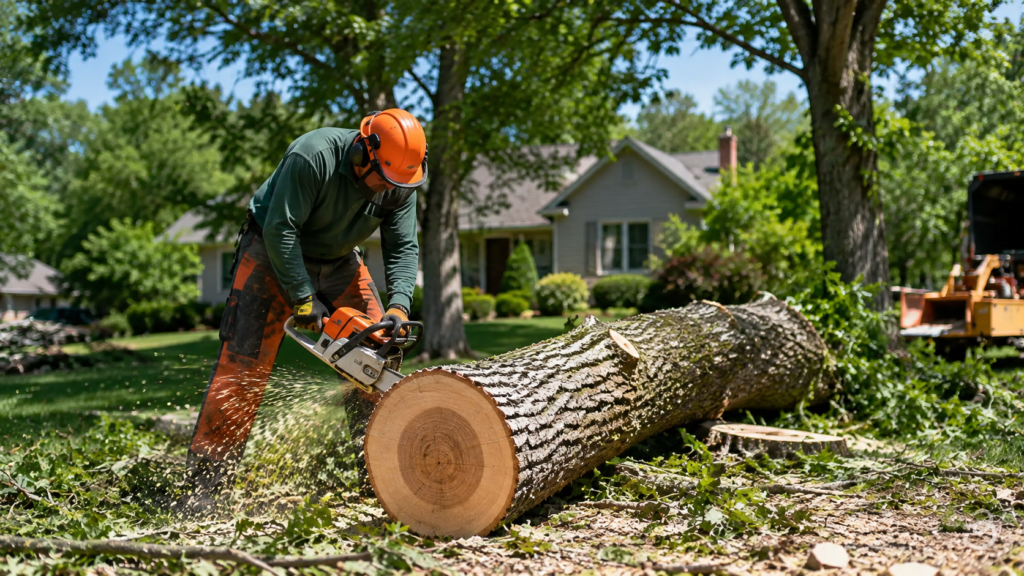
Tree Cutting Near Me: When to Cut, Who to Call, and How Much It Costs
Searching for tree cutting near me usually means something specific is happening on your property. Maybe a branch is suddenly hanging over your roof, a tree is leaning after a storm, or a fallen limb has you looking up at other hazards. Whatever brought you here, it’s worth thinking through your options before making the call.Properties in Geneseo and Livingston County face unique tree challenges. Whether it’s mature oaks on older village lots, silver maples encroaching on structures, or ash trees showing emerald ash borer damage, these structural issues require a precise local response. Here is what you need to know about tree cutting types, hazard signs, local New York permits, and what a professional operation looks like from assessment to final cleanup.
Difference Between Cutting, Trimming, and Full Removal
These terms get used interchangeably, and they shouldn’t. They describe different scopes of work with different costs, timelines, and outcomes.Trimming is selective. It targets specific branches, deadwood, crossing limbs, low-hanging branch removal along a roofline or driveway, or canopy shaping to reduce storm load on one side of the tree. The tree stays. The goal is improving its structure, health, or clearance without changing its overall presence on the property.Cutting is broader. It typically refers to removing significant portions of the tree, major scaffold branches, a co-dominant stem that’s become a hazard, or crown reduction that brings an overgrown canopy back to a manageable size. Still not full removal, but more than maintenance pruning.Full removal takes the entire tree to stump level. It’s the right call when the tree is dead, structurally compromised beyond what pruning can address, causing foundation or utility conflicts that won’t resolve any other way, or is a species causing ongoing problems. Overgrown tree hazard removal in Geneseo often involves ash trees that have progressed past the point where any intervention preserves them.Hazard Signs That Mean a Tree Needs Cutting Now
Some things can wait for a scheduled appointment. Others can’t.Dead branches in the upper canopy that haven’t dropped yet will drop. The question is when and what’s underneath when they do. A dead limb over a driveway, a play area, or a roofline is an active hazard regardless of how stable it looks in calm weather. Wind events in Livingston County move fast, and a branch that’s been sitting there for two seasons can come down in a thirty-minute storm.Vertical cracks running down the trunk indicate internal stress. On a healthy tree, the wood fibers run together and hold. When they separate, the crack is the visible evidence of a structural failure that’s already underway.Co-dominant stems, two main trunks growing from the same base with a tight V-shaped union, are one of the most common hazard patterns in Livingston County maples and oaks. The union where they meet lacks the interlocking wood grain of a proper branch attachment. Under ice loading or high wind, they split at that union, and the failure is sudden. Tree removal near me calls after ice storms in this region frequently involve co-dominant stem failures that were visible and addressable before the storm hit.Fungal growth at the base of the trunk or along the root flare signals internal decay. The fruiting body on the outside is the late-stage evidence of a process that’s been happening inside the wood for months or years. A tree with active fungal growth at the base needs a structural assessment before the next significant weather event.Leaning that developed after a storm is different from a tree that’s always had a slight lean. A new lean means the root plate moved. That movement doesn’t reverse, and the structural situation underground is different from what it was before the event. Don’t wait on this one.Permits Required for Tree Cutting in New York State
New York State doesn’t have a statewide tree removal permit requirement for trees on private property. However, local municipalities do, and they vary significantly.In the Village of Geneseo, trees in the public right-of-way, the strip between the sidewalk and the street, fall under village jurisdiction and require approval before any work begins. Removing or significantly trimming a street tree without going through the proper process can result in fines and a requirement to replace the tree at your expense.For trees on private property within village limits, permit requirements depend on the specific ordinance and in some cases the tree’s size or species. Livingston County parcels outside village limits generally have fewer restrictions on private property tree work, but utility easements and DEC regulations apply near wetlands and protected areas.The practical answer: before any significant tree cutting in Geneseo NY, ask the crew you’re hiring whether permits apply to your specific situation. A legitimate tree trimming company operating in this area knows the local requirements and handles that coordination as part of the job.What Time of Year Is Best for Cutting?
The honest answer is that hazard work gets done when it needs to be done, regardless of season. A dangerous limb over a roof in August doesn’t wait until dormancy.For non-emergency cutting and pruning, late fall through early spring, after leaf drop and before new growth, is the preferred window for most species. Dormant trees have stopped actively moving nutrients and energy through the vascular system, which means cuts close more cleanly and the tree expends less energy responding to the wound. Disease transmission risk for certain species, particularly oak wilt, is also lower during dormancy.Oaks specifically should be pruned in winter when possible. Oak wilt is spread by beetles that are active during warmer months and are attracted to fresh pruning cuts. A pruning wound made in January carries far less disease transmission risk than the same cut made in June.Ash trees affected by emerald ash borer don’t follow the same seasonal logic because the timing of intervention is driven by the infestation stage, not the calendar. An ash that’s structurally compromised needs to come down when conditions allow safe removal, not when the season is ideal.For ornamental trees and shrubs in Geneseo landscapes, late winter pruning, February through early March before bud break, produces the most vigorous spring response. The plant pushes new growth into a well-structured canopy rather than trying to recover from a midsummer cut.How Much Does Tree Cutting Cost?
Tree cutting costs in Geneseo depend entirely on size, accessibility, and hazard levels. Basic tree trimming ranges between $200 and $800. Full removals scale from $300 for small trees up to $2,000+ for large, mature village oaks or compromised ash trees requiring complex rigging and specialized equipment near residential structures.Safety During Tree Cutting Operations
This is where the difference between a professional crew and an unlicensed operator becomes most apparent.Professional tree cutting involves working at height, around utility lines, with chainsaws and rigging equipment, on wood that doesn’t always behave predictably. Each of those factors individually requires training and proper equipment. Combined, they require a crew that’s been trained specifically in arboricultural operations, not just general construction or landscaping work.The specific risks on a Geneseo residential property: utility lines running through tree canopies, older trees with internal decay that isn’t visible from the outside, and lot configurations that don’t always provide a clean drop zone away from structures. A crew that assesses these variables before cutting and adjusts their method accordingly is operating safely. A crew that shows up and starts cutting without that assessment is creating liability on your property.Homeowner safety during a professional cutting job is straightforward: stay out of the work zone. The area beneath and around the tree should be clear of people and pets from the moment the crew starts setup until they’ve confirmed the site is clear. Falling wood, rigging lines under tension, and moving equipment all create hazards that aren’t obvious to someone watching from what feels like a safe distance.Our Certified Team’s Cutting Process
Every job starts with a ground-level assessment before equipment comes off the truck.Our ISA-certified arborists walk the tree and the surrounding area. Species, structural condition, lean, root plate stability, proximity to structures and utilities, and ground conditions all get evaluated. The removal or cutting method gets determined by what the assessment shows, not by what’s fastest or simplest.For trimming and pruning work, cuts get made at the proper attachment point to allow the tree to close the wound effectively. Flush cuts and topping cuts, leaving stubs or removing the central leader, aren’t how Galbraith Tree & Shrub operates. Improper cuts create decay entry points and structural problems that cost more to address later than the original pruning job was worth.For cutting and removal work, the sequence gets planned before anyone climbs or positions equipment. Escape routes, rigging points, drop zone clearance, and communication between crew members are established during setup. The cutting follows a planned sequence that accounts for how the tree’s weight will shift as sections come off.Cleanup runs alongside the work, not after. Brush goes into the chipper continuously, log sections get staged clear of the work zone, and the site gets walked before the crew loads out.Free Assessment: When to Call Us vs. DIY
Some tree work is genuinely manageable for a capable homeowner with the right tools. Most isn’t.DIY is reasonable for: removing small, dead branches under two inches in diameter from ground level on trees with no proximity to structures or utilities, basic cleanup of fallen small-diameter material, and light pruning of ornamental shrubs well within reach from the ground.Call a professional for: anything that requires climbing or working at height, any cutting near utility lines, any tree showing structural hazard signs, any removal where the drop zone is limited by structures or fencing, and any work on trees over twenty feet. Low-hanging branch removal that requires a ladder and a chainsaw near a roofline or utility connection is not a DIY job regardless of how accessible it looks.FAQs
1. What is the difference between trimming and cutting?
Trimming targets specific branches to improve the tree’s health, structure, or clearance. Cutting is a broader scope of work that removes major scaffold branches or reduces the canopy to manage hazards without removing the entire tree.2. How do I know if a tree needs immediate cutting?
Look for critical hazard signs like hanging dead limbs over structures, vertical trunk cracks, co-dominant stems with tight V-unions, fungal growth at the base, or a sudden lean that developed after a recent storm.3. Do I need a permit to cut down a tree in Geneseo, NY?
New York has no statewide private property permit requirement. However, the Village of Geneseo requires approval for right-of-way street trees, and local ordinances vary based on your specific parcel location and tree size.4. When is the best time of year to cut or prune trees?
Emergency hazards are handled immediately. For non-emergencies, late fall through early spring dormancy is ideal. Pruning during this window minimizes energy loss, allows cuts to close cleanly, and reduces disease transmission risks like oak wilt.5. Why should ash trees be cut down quickly if damaged?
Ash trees infested by the emerald ash borer degrade rapidly and become highly brittle. They do not follow seasonal pruning logic; they must be removed safely as soon as structural compromise is identified.6. Can I cut down or trim large tree branches myself?
DIY is only safe for small, ground-level branches under two inches in diameter. Anything requiring climbing, ladders, chainsaws near roofs, or work near utility lines requires a fully trained and equipped professional crew.7. What should I expect during a professional tree cutting process?
A professional job includes a thorough ground-level safety and structural assessment, a planned rigging and cutting sequence using proper arboricultural techniques, continuous brush chipping, and a complete site cleanup before the crew departs.Keep Reading
More from the blog
Practical guidance on looking after the trees on your property.
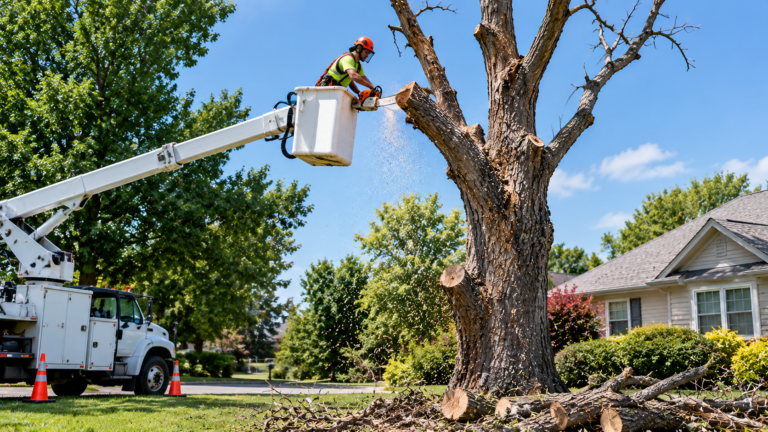
Dead Tree Removal Geneseo: When to Remove & Safety Risks
A dead tree rarely announces itself. One summer the maple by the driveway leafs out late, the next it doesn’t leaf out…
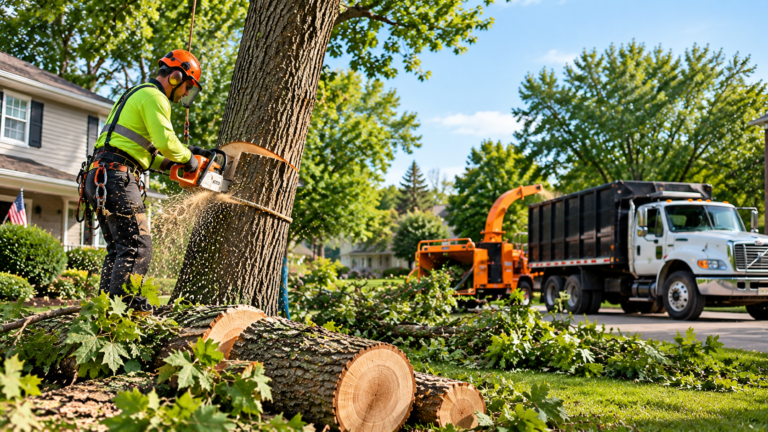
Affordable Tree Removal Near Me: Budget Options Without Compromising Safety
When a tree becomes damaged, diseased, unstable, or simply outgrows its space, removing it may be necessary to protect your property. However,…
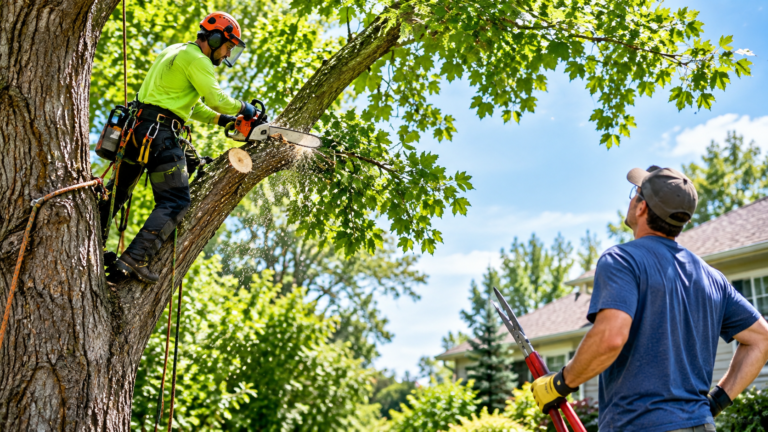
Tree Trimming Company Guide: Certified Arborists vs DIY (Why It Matters)
A branch hangs over your roof, and you wonder if you can handle it yourself. Maybe you can. Plenty of trimming is…