
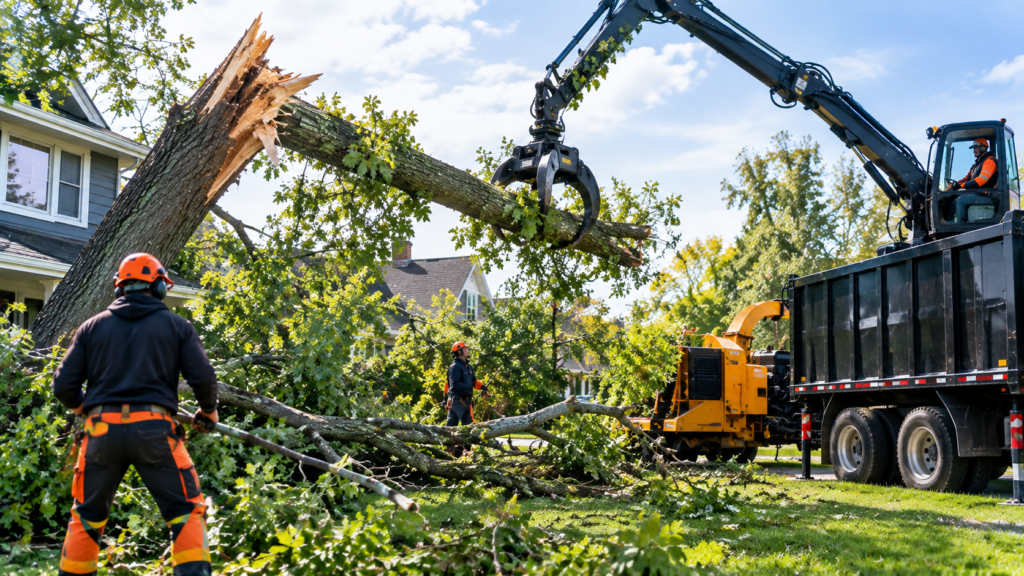
Emergency Tree Removal in Geneseo, NY: Fast Response, Safe Removal
Geneseo gets hit harder by weather than most people expect for a town this size. Lake-effect bands roll off the Genesee Valley all winter and pile ice on branches until something gives.
Summer brings downbursts that can drop a sixty-foot maple across a driveway in about four seconds. When that happens to your property, you’re not thinking about lawn care anymore.
You’re thinking about your roof, your car, and whether it’s safe to walk outside. That’s the moment people start searching for emergency tree removal in Geneseo, NY, crews who actually pick up the phone.
Our crew at Galbraith Tree & Shrub has pulled trees off garages during ice storms on Route 20A. We’ve cut through downed oaks blocking driveways at three in the morning so an ambulance could get through. This work doesn’t wait for business hours, and neither do we.
Quick answer: If a tree has fallen on your house, vehicle, or across your driveway in Geneseo, call for emergency service in Geneseo, NY right away, keep everyone clear of the tree and any wires it’s touching, and don’t attempt to cut it yourself.
A trained crew can typically reach a Livingston County property within a few hours of the call, sometimes faster depending on road conditions and how many other jobs the storm has stacked up.
The Tree Emergencies We See Most Often Around Geneseo
Most of our emergency calls fall into a handful of patterns, and if you live here long enough, you start to recognize them.
Ice storms are the big one. A half-inch of ice adds hundreds of pounds to a mature limb, and it doesn’t take much wind after that to bring the whole thing down. We see this constantly along the tree lines near SUNY Geneseo and the older neighborhoods with big silver maples planted fifty or sixty years ago.
Wind events are close behind. A summer thunderstorm with a fast-moving gust front can snap trees that looked perfectly healthy the day before. Root systems in saturated soil, common after a wet spring, just can’t hold against that kind of lateral force.
Then there’s the slow-motion emergency: dead ash trees. Emerald ash borer has worked through this region for years, and a lot of homeowners don’t realize how brittle a dead ash gets until a branch comes through a skylight. That’s dangerous tree removal, Geneseo territory, not a weekend DIY project.
And of course, the call nobody wants to make: a tree fallen on a house structure, with someone still inside. We treat those calls differently from the moment the phone rings, and we’ll get into how below.
Storm damage tree removal in Geneseo requests spike hard after any named storm system passes through, and our dispatch board fills up within the hour.
Our 24/7 Emergency Call-Out System
Here’s how it actually works when you call.
A real person answers, not a machine that routes you into a hold queue. We ask a few quick questions: Is anyone hurt? Is the tree touching a power line? Is it blocking the only way in or out of the property? Those answers decide how fast we move and who we send.
Once we know the basics, we dispatch a crew with the right equipment for the job.
A leaning ash over a bedroom needs a different approach than a downed limb across a side yard. Our 24-hour tree service dispatch stays staffed through the night during active storm systems, because that’s when most of these calls come in.
Galbraith Tree & Shrub runs this system year-round, not just when the forecast looks bad. Storms don’t wait for convenient timing, so neither do we.
Priority Triage: Which Trees Come Down First
When a storm rolls through and the phones start ringing, we can’t get to every call at once. Emergency tree removal in Geneseo, NY: requests get sorted the moment they come in, not in the order they arrived. So we triage, and the order matters.
Trees on top of a structure with people inside come first, every time. No exceptions. Next are trees blocking emergency access, a driveway, or a road where someone needs to get out. After that, trees leaning toward a structure but not yet touching it move up the list, because a shift in wind can change everything fast.
Trees resting on active power lines get handled differently. We don’t touch those. We call the utility company, secure the area, and wait for the line to be de-energized before anyone gets near it with a chainsaw.
This sounds obvious, but it’s the step that gets skipped by homeowners who try to clear things themselves, and it’s the one that causes the worst injuries.
Lower-risk situations, like a big limb down in an open yard with nothing under it, get scheduled once the higher-priority calls are handled. Usually that’s still same-day.
Working With Insurance Adjusters After a Storm
This part surprises people. Insurance doesn’t move at storm speed, and the paperwork matters as much as the chainsaw work.
Before we cut anything that isn’t an immediate safety hazard, we take photos.
Wide shots of the whole scene, close shots of the damage, and anything showing the tree’s condition before removal, like rot or a split trunk. Adjusters want to see the cause, not just the aftermath.
We also keep an itemized breakdown of the work: removal, debris hauling, stump grinding if needed, and any structural damage the tree caused on its way down. Homeowners policies typically cover tree removal when the tree falls on a covered structure, but coverage for trees down in the yard with no damage varies a lot by policy.
We’re happy to talk through what we’re seeing and put it in writing so your adjuster has something concrete to work from.
One tip that saves people a headache: don’t let anyone haul off debris before the adjuster has seen it, unless it’s blocking emergency access. Once it’s gone, it’s harder to document.
Keeping the Site Safe, Before and After Removal
A downed tree looks like the danger. Sometimes the bigger danger is what’s still standing.
Hung branches, sometimes called widowmakers, are broken limbs still caught in the canopy above. They look stable, and they’re not. Before we start cutting, we walk the site and identify anything overhead that could drop without warning. We rope off the work zone and keep people, including curious neighbors, well outside that radius.
Chainsaw work under tension is its own hazard. A trunk that’s bent or wedged against a structure can release stored energy unpredictably when the first cut goes in. Our crews plan the cut sequence before the saw ever starts, not while it’s running.
After the tree is down and cleared, we check the structure it landed on, even if the damage looks minor from the ground. Roof decking, gutters, and siding can hide damage that only shows up once you’re actually up there.
We’ll point out anything we see so you can pass it along to a contractor or your insurance adjuster.
How Fast Can We Get to Your Property?
Response time depends on where you are and what the storm has done to the roads, but we cover Geneseo and the surrounding Livingston County towns, including Mount Morris, Avon, and Lakeville. In most cases, we’re on-site within a few hours of your call.
During a widespread storm event, when dozens of properties are calling at once, response times stretch out for lower-priority jobs. That’s the honest answer, not a sales pitch. What doesn’t change is the order of operations: life-safety situations and blocked access always jump the line, regardless of when you called.
If you’re not sure whether your situation counts as an emergency, call anyway. We’d rather talk you through it on the phone than have you guess wrong about a leaning tree over your kids’ bedroom.
That’s the whole point of emergency tree removal in Geneseo, NY: no guesswork, no waiting to see if it gets worse overnight.
Prevention: Tree Risk Assessments Before Storms
The best emergency call is the one that never happens. A tree risk assessment, done before storm season, catches a lot of what turns into a 2 a.m. emergency later.
We look for the usual warning signs: cracks in the trunk, fungus at the base, dead limbs in the upper canopy, root heaving in the soil around the base, and a lean angle that’s changed since last year.
Ash trees get extra attention given how common emerald ash borer damage is in this area. A tree that looks fine from the driveway can be hollow at the core, and you’d never know without someone actually looking.
If we find something concerning, removing it on a calm, dry afternoon is a completely different job than removing it during a windstorm at midnight. It costs less, it’s safer for our crew, and it means one less call to Galbraith Tree & Shrub during the next storm.
We offer these assessments year-round, and fall is usually the smart time to book one before winter loading starts.
Geneseo homeowners who’ve been through one bad storm season tend to call for an assessment every year after that. It’s a cheap habit that prevents an expensive night.
Frequently Asked Questions
How much does emergency tree removal cost in Geneseo, NY?
Cost depends on tree size, location, and access. A straightforward removal in an open yard costs less than one tangled in power lines or resting on a roof. We give a clear estimate before starting whenever the situation allows for it.
Will my homeowners insurance cover a tree that fell on my house?
Usually, yes, if the tree caused damage to a covered structure. Coverage for a tree down in the yard with no damage depends on your specific policy. We document everything so your adjuster has clear photos and a written scope to work from.
How fast can a crew reach my property after a storm?
Most Geneseo and Livingston County properties see a crew within a few hours of the call. During widespread storm damage, response times shift based on priority, with life-safety situations always handled first regardless of call order.
Is it safe to remove a fallen tree myself?
Not if it’s under tension, touching power lines, or resting on a structure. Stored energy in a bent trunk can release unpredictably. If you’re unsure, it’s worth a call before picking up a chainsaw.
What should I do first if a tree falls on my house?
Get everyone out and away from the tree and any wires. Don’t go back in to grab belongings. Call for emergency removal, then call your insurance company once the immediate danger is handled.
Do you handle trees that are leaning but haven’t fallen yet?
Yes. A leaning tree over a structure or driveway is treated as high priority, especially after heavy rain has saturated the root zone. Waiting for it to fall removes your options for a controlled, safer removal.
How often should I get a tree risk assessment?
Once a year is a reasonable rule, ideally before winter or right after a major storm season. Trees change condition faster than people expect, and a quick look now beats an emergency call later.
Keep Reading
More from the blog
Practical guidance on looking after the trees on your property.
Emergency Tree Removal: What to Do Right Now (Action Guide)
A tree doesn’t ask permission before it comes down. One minute it’s just another maple in the yard, and the next it’s…
Tree Removal Cost Guide 2026: What You’ll Actually Pay
Every fall, we get the same call. A homeowner in South Buffalo or Amherst looks at a leaning silver maple and asks,…
Affordable Tree Service in Geneseo, NY: Quality Care That Fits Your Budget
Twenty-some years of cutting, climbing, and grinding stumps in this county, and I still hear the same question first. “What’s this going…