
Emergency Tree Removal Near Me: 24/7 Service You Can Count On
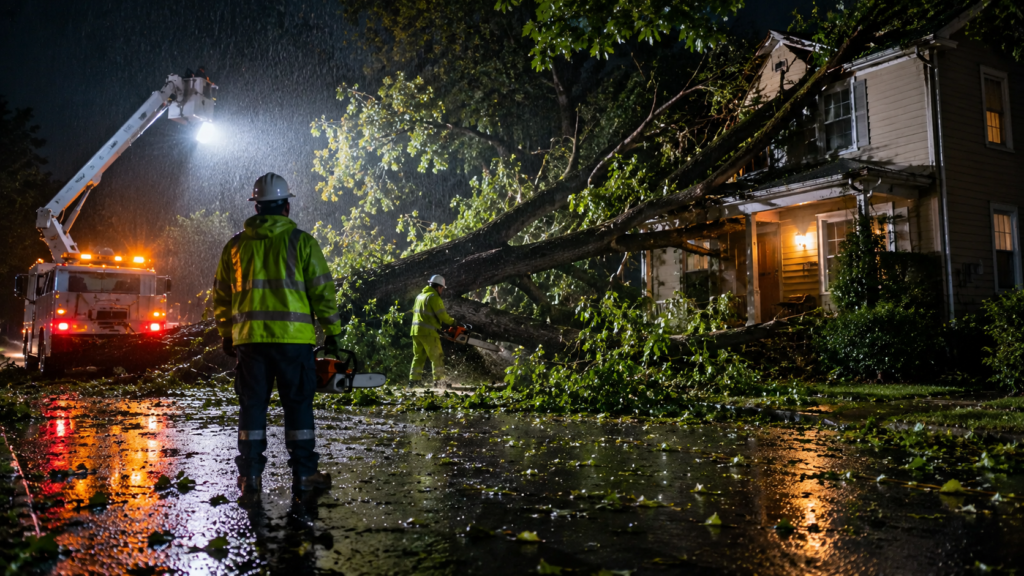
A tree comes down on a Livingston County property, and the first thing most homeowners do is stand there for a minute, trying to figure out what they’re actually looking at.
Is it on the house? Is it blocking the only way out of the driveway? Is that branch still connected to the trunk, or is it hanging by enough wood fiber to come down on its own in the next hour? The situation looks different at 2 am in the middle of a storm than it does in daylight with time to think.
Searching for emergency tree removal near me at midnight during a wind event is not the time to be evaluating companies. Knowing who to call before something happens and understanding what to expect when you do call makes a genuinely bad situation easier to get through.
This covers what qualifies as a true tree emergency, how response works in the Geneseo and Livingston County area, what happens when you call after hours, and what to do in the time between the tree coming down and the crew arriving.
What Situations Require Emergency Tree Removal?
Not every fallen tree is an emergency.
Some situations are urgent. Some can wait until morning. Knowing the difference helps you communicate clearly when you call and helps the crew prioritize correctly across multiple calls during a major storm event.
True emergencies, situations that need a response tonight, not tomorrow:
A tree or major limb on a structure. Roof, wall, vehicle, fence line attached to a structure, anything where continued contact creates progressive damage or structural risk. A tree resting on a roof isn’t stable. Its weight shifts as it settles, as wind moves it, and as rain soaks into the wood. The longer it sits, the more damage accumulates.
A tree is blocking the only access to the property. If the driveway is blocked and there’s no alternate way in or out, that’s an emergency regardless of whether the tree hit anything. Emergency vehicles need to be able to reach the property.
A hanging limb directly over an occupied area. A partially attached limb suspended over a doorway, a walkway, or anywhere people need to pass is an active falling hazard. The fiber holding it is under tension and can release without additional wind or weather.
A tree leaning against a utility line. Contact between wood and an energized line creates a fire risk and a potential electrocution hazard. This situation requires a call to the utility company simultaneously with the tree service call; the utility needs to de-energize the line before any crew approaches the tree.
-Situations that are serious but can wait until morning with precautions:
A tree down in the yard with no contact with structures or utilities. Secure the area, keep people and animals away from it, and call first thing in the morning for a scheduled response.
Storm damage that’s visually concerning but stable. A split limb that’s still attached and not over anything critical can wait for daylight assessment. Document it and don’t go near it, but it doesn’t require a midnight crew.
How Fast Can a Local Company Respond?
When you need emergency tree service near me, response time depends on three key factors: your property’s distance from our shop, overall call volume during a storm, and the specific equipment required for the job.
In the Geneseo and Livingston County area, a local crew responding to a single property emergency can typically arrive within one to two hours of the call.
During a widespread storm event, the kind that takes down multiple trees across the county simultaneously, response times extend because the same crew is working through a prioritized list of calls rather than responding to one at a time.
This is why how you describe the situation when you call matters. A crew dispatching to multiple locations during a storm event prioritizes based on what callers tell them. “Tree in the yard” gets categorized differently than “tree on the roof with the ceiling cracking.” Be specific. What’s the tree on or near? Is anyone in immediate danger? Is there a utility contact? Those three questions determine where your call lands in the response sequence.
Local matters here.
A 24-hour tree service, that operating out of a shop thirty miles away in a different county takes longer to reach a Geneseo, NY, property than one based in this area.
During a regional storm, out-of-area companies are also handling calls across a wider geography. A local crew has a shorter radius and gets there faster.
Night and Weekend Call-Outs: What to Expect
After-hours emergency tree work is different from a scheduled daytime job, and understanding those differences prevents frustration on both sides.
The crew responding after midnight has been dispatched from home, not from a shop where everything is staged and ready. Equipment arrives, the situation gets assessed, and the scope of what can safely be done in the dark with available lighting gets determined on site. Not every job that needs doing at 2 am can be fully completed at 2 am.
What the crew can always do is stabilize the situation, get the active hazard addressed so the property is safe until full work can be completed in daylight.
Expect an emergency surcharge on after-hours calls.
This is standard across the industry and reflects the real cost of dispatching a crew outside normal hours. Any legitimate emergency tree removal company applies this. Companies that don’t charge after-hours rates are either building it into an inflated base price or cutting corners somewhere else in how they operate.
What you should expect from the crew regardless of the hour: an honest assessment of the situation before any cutting starts, clear communication about what they can accomplish tonight versus what needs to wait for daylight, and a safe work zone established before anyone gets close to the tree.
What you shouldn’t expect: a complete final cleanup, stump grinding, or full debris removal at 3 am during an active storm. The emergency response addresses the hazard. The full scope of work gets completed in follow-up visits.
Temporary Securing vs. Full Removal Decisions
This is the call that gets made on site, and it’s worth understanding how that decision happens.
Full removal is the right answer when the tree is already down, when it’s structurally compromised to the point where leaving any portion standing creates an ongoing hazard, or when partial removal is what it takes to get the weight off a structure.
Most emergency calls involving a tree on a roof or a tree across a driveway resolve with full removal because leaving the tree in place doesn’t actually solve the problem.
Temporary securing is appropriate when a tree has partially failed; a major limb has split but still attached; a tree has a significant lean that hasn’t fully fallen; and conditions don’t allow safe full removal right now.
A crew working at night in active weather has real limitations. Getting a cabling system or support structure on a partially failed tree and coming back in daylight with full equipment is sometimes the safer call than attempting a complete removal in unsafe conditions.
The arborist on site makes this call based on the specific tree, the specific conditions, and what’s at risk if the situation changes overnight. Trust that assessment. A crew recommending temporary securing isn’t avoiding the job; they’re managing the risk correctly given what they have to work with at that moment.
How Galbraith Prioritises Emergency Calls
When storm fronts roll through Livingston County, calls pile up fast.
We run a strict triage system focused on life safety and property preservation. First priority goes to trees crushing occupied homes or tangled in power lines, followed immediately by blocked driveways where residents or emergency responders can’t get in or out.
If a tree is down strictly in the yard and isn’t actively threatening a structure, we log it and handle it right after active hazards are secured.
Documenting Tree Damage for Insurance
Do this before the crew arrives. It takes ten minutes, and it matters for what comes next.
Photograph everything from multiple angles before anything gets moved. The tree in its fallen position, the contact point with the structure, the damage to the structure, and the surrounding area. Take a video if the still photos don’t capture the full extent. Timestamp matters; most phone cameras embed this automatically.
Note the time the tree came down if you know it, the weather conditions at the time, and whether there were any prior signs of tree distress. Prior signs of distress, visible decay, previous limb failures, and a known lean can affect how an insurance claim is evaluated. If you had concerns about the tree before it fell and raised them with anyone, document that.
Call your insurance company as soon as it’s safe and practical to do so. Most homeowner policies cover storm tree damage near me scenarios where a tree falls on a structure, but the specific coverage and what it includes for debris removal vary.
The insurance company will want documentation of the damage in its initial state before cleanup begins. The photos you took before the crew arrived are what they need.
Don’t sign anything or agree to any full scope of work until you’ve spoken with your insurance company.
Service Map: Towns We Cover in Livingston County
Emergency tree removal in Geneseo, NY, and surrounding Livingston County communities is the core of Galbraith Tree & Shrub’s emergency response coverage.
Towns and communities served for emergency response:
Geneseo – including village properties, rural parcels on the Geneseo town line, and properties along the Genesee River corridor where storm and flood-related tree damage is most common.
Avon – residential and rural properties throughout the town, including areas bordering Monroe County where storm tracks frequently move through.
Livonia – including Livonia Center and properties along Conesus Lake, where wind exposure from the water accelerates storm damage on lakeshore trees.
Mount Morris – including properties near Letchworth State Park’s northern boundary where mature hardwood populations are dense, and storm damage is common after significant weather events.
Lakeville – waterfront properties, residential neighborhoods, and high-traffic corridors around the north end of Conesus Lake, where heavy lake winds and saturated soil frequently cause mature trees to uproot or split during sudden storm fronts.
Conesus – rural parcels, wooded hillsides, and sharp elevation drops along the eastern side of the lake, where heavy snowfall, ice accumulation, and high winds regularly snap large limbs and bring down aging timber across access roads.
Leicester – farmland, country lots, and village homes along the Genesee River basin, where wide-open valley winds push through mature tree lines, frequently dropping heavy branches onto outbuildings, driveways, and fence lines.
Binghamton – hillside residential properties, older urban neighborhoods, and steep river valley lots across the Southern Tier, where dense, aging oak and maple canopies face heavy ice loading in winter and severe runoff-driven root compromise during heavy summer storms.
All covered for emergency response with response times varying by distance from the Geneseo base.
If your property is in Livingston County and you’re not sure whether it falls within the coverage area, call. The answer is almost always yes, and the response time question gets answered specifically based on your location.
Frequently Asked Questions
What should I do immediately after a tree falls on my property?
Get everyone inside and away from the tree. Don’t attempt to move it or assess contact with utilities yourself. Call 911 if there’s any risk to life, then call your tree service. Document with photos before anyone touches anything. Stay clear until the crew arrives and assesses the situation.
Does homeowner’s insurance cover emergency tree removal in Livingston County?
Most policies cover removal when a tree damages a structure. Coverage for trees down in the yard with no structural contact varies significantly by policy. Document everything before cleanup begins and call your insurer before authorizing full-scope work beyond the immediate hazard response.
How much does emergency tree removal cost compared to a scheduled job?
After-hours emergency response typically runs 1.5 to 2 times the cost of the same work done during normal hours. The surcharge covers crew dispatch, after-hours labor, and the operational cost of maintaining emergency availability. Get a written estimate before authorizing work beyond immediate hazard stabilization.
What happens if a tree falls on power lines near my property?
Stay far back and call your electric utility immediately to de-energize the line. Do not attempt to touch the tree or call a tree service until power company crews confirm the area is completely safe.
Can a crew safely remove a tree at night during an active storm?
Experienced crews work at night in weather conditions regularly, but active lightning, high sustained winds, or limited visibility can restrict what’s safely possible. The crew assesses conditions on arrival. Stabilizing an immediate hazard is always possible. Full removal sometimes needs to wait for safer conditions.
Do I need to be home when the emergency crew arrives?
No, as long as the crew has clear access to the tree and active hazards are outside. We can stabilize the situation, take photos, and contact you directly by phone to discuss the next steps.
Will insurance pay the tree service company directly for emergency removal?
It depends on your policy. Some insurers pay contractors directly via direct billing, while others require you to pay up front and reimburse you after you submit our itemized invoice and photos.
Keep Reading
More from the blog
Practical guidance on looking after the trees on your property.
Emergency Tree Removal: What to Do Right Now (Action Guide)
A tree doesn’t ask permission before it comes down. One minute it’s just another maple in the yard, and the next it’s…
Tree Removal Cost Guide 2026: What You’ll Actually Pay
Every fall, we get the same call. A homeowner in South Buffalo or Amherst looks at a leaning silver maple and asks,…
Affordable Tree Service in Geneseo, NY: Quality Care That Fits Your Budget
Twenty-some years of cutting, climbing, and grinding stumps in this county, and I still hear the same question first. “What’s this going…