
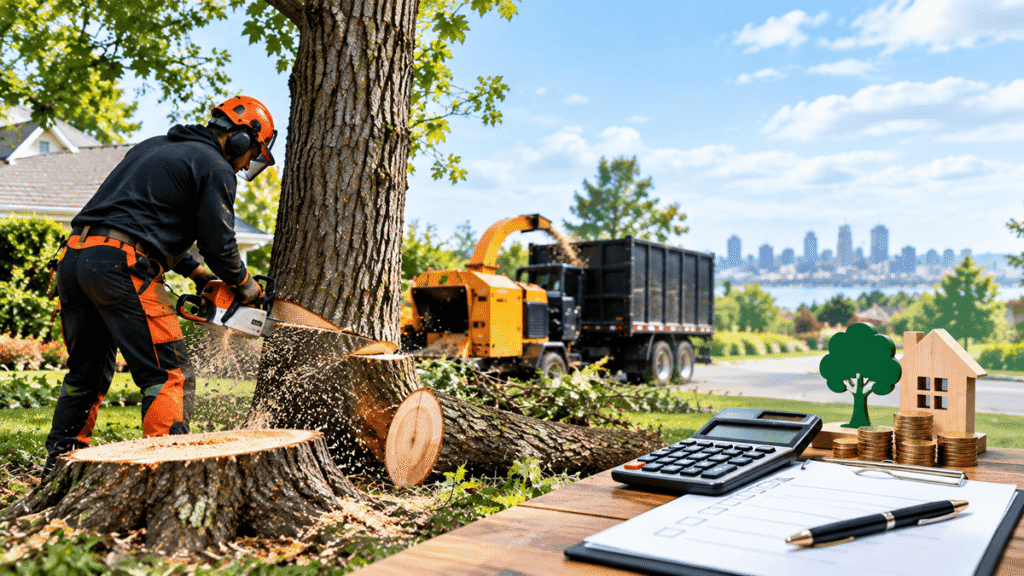
Tree Removal Cost Guide 2026: What You’ll Actually Pay
Every fall, we get the same call. A homeowner in South Buffalo or Amherst looks at a leaning silver maple and asks, “How much is this actually going to cost me?” Fair question. Tree removal cost isn’t a flat number; it swings based on size, location, condition, and a handful of factors most people never think about until they’re staring at a quote. This guide breaks it down honestly, the way we’d explain it standing in your yard.
Quick Answer
For most Buffalo homeowners, tree removal cost falls between $400 and $1,800 for a standard residential tree. Small trees under 30 feet run on the lower end. Large, mature trees, especially ones near power lines, structures, or in tight backyards, push toward the higher end or beyond. Stump removal, permits, and cleanup are usually separate line items.
What Determines Tree Removal Cost
There’s no single price list that applies to every job, and honestly, any company that quotes you sight-unseen over the phone is guessing. Tree removal cost depends on the tree’s height and trunk diameter, how close it is to your house, garage, fence, or power lines, and the condition of the tree; dead, diseased, or leaning trees often require more careful rigging and access.
A tree with a clear drop zone in an open yard costs less to remove than one wedged between two houses where every branch has to be roped down piece by piece.
Root system and soil condition matter too, particularly here in Buffalo where clay-heavy soil and winter freeze-thaw cycles can leave trees with shallower, less stable root structures than you’d expect. That instability sometimes means more careful, and more time-consuming, removal work.
Average Tree Removal Cost by Tree Size
Breaking it down by size gives homeowners a more useful starting point than a single average. Small trees, generally under 30 feet, tend to run $150 to $500.
Medium trees between 30 and 60 feet, a lot of maples and ash trees around Buffalo fall into this range, typically cost $500 to $1,200. Large trees over 60 feet, including big oaks and mature pines, can run $1,200 to $2,500 or more, especially if crane work is needed.
These are general ranges, not guarantees. A 40-foot tree in an open field costs a fraction of what a 40-foot tree wedged against a roofline costs. That’s why an in-person estimate always beats a phone quote.
Emergency vs Planned Removal Pricing
This is where a lot of homeowners get caught off guard. Planned removal, scheduling a company to take down a tree on your timeline, is almost always cheaper than emergency removal after a storm.
When a tree comes down on a house or blocks a driveway after a lake-effect snowstorm, you’re paying for immediate response, after-hours labor, and sometimes specialized equipment to safely clear storm damage.
If you’ve got a tree that’s clearly declining, thinning canopy, fungus at the base, or cracking bark, it’s worth scheduling removal before it becomes an emergency. You’ll pay less, and you won’t be making a rushed decision during a crisis.
Stump Grinding and Removal Add-On Costs
Tree removal cost typically doesn’t include the stump unless you ask for it upfront. Stump grinding usually adds $100 to $400 depending on trunk diameter, and full stump removal, pulling the root ball out entirely, costs more since it’s more invasive and often requires backfilling the hole afterward.
Some homeowners choose to leave the stump and grind it down later, which is fine, but it’s worth asking your tree removal company for a combined quote if you know you want it gone. Bundling it into the original job is usually cheaper than calling back out later.
Permits and Local Regulations in Buffalo
Buffalo and its surrounding towns have varying rules on tree removal, particularly for street trees or trees on the property line, which may technically belong to the city. Before any work starts, it’s worth checking with your local municipality; Buffalo, Cheektowaga, Amherst, and West Seneca all handle this a little differently.
Some require a permit for removing large trees, especially healthy ones over a certain diameter, even on private property.
A reputable tree removal company should know the local permitting requirements and help you navigate them, but the responsibility for pulling a permit typically falls on the property owner. Skipping this step can result in fines, so it’s worth the extra phone call before removal day.
Factors That Increase Cost
A few specific conditions consistently push tree removal cost higher. Proximity to power lines is a big one; utility companies sometimes need to be involved to de-energize or protect lines before work can safely proceed, which adds time and coordination. Trees growing at an angle or leaning toward a structure require more careful rigging to control the direction of the fall.
Limited access is another factor; if a crew can’t get a truck or chipper close to the tree, everything has to be done by hand or hauled out manually, which adds labor hours.
And diseased or hazardous trees, particularly ones affected by emerald ash borer (which has hit ash trees hard across Western New York), sometimes require extra caution since the wood can be more brittle and unpredictable.
DIY vs Hiring a Tree Removal Company
We get it, a chainsaw and a weekend can feel like a way to save money. For small, low-risk trees far from structures, that might be reasonable if you have experience and the right safety gear.
But for anything over 20 feet, near a house, or leaning in an unpredictable direction, this is genuinely dangerous work. Tree removal is consistently ranked among the more hazardous jobs in the country, and most DIY injuries happen from underestimating a tree’s weight distribution or fall path.
Hiring a tree removal company also covers you for liability and cleanup, which matters more than people expect until a limb lands on a fence or a neighbor’s shed.
Red Flags When Searching “Affordable Tree Removal Near Me”
If you’re searching for affordable tree removal near me, be cautious of quotes that seem dramatically lower than everyone else’s, especially from companies with no local address, no proof of insurance, or vague answers about who’s actually doing the climbing. A too-good-to-be-true price often means the crew is uninsured, which puts you on the hook if something goes wrong on your property.
Ask for proof of liability insurance and workers’ comp coverage before anyone touches a chainsaw on your land. It’s a fair question, and any legitimate company will have that paperwork ready without hesitation.
Seasonal Timing and Cost
Tree removal pricing 2026 tends to run slightly lower in late fall and winter, since demand drops once the leaves are down and storm season slows. Spring and summer are busier, partly because trees are easier to assess with full foliage and partly because storm damage tends to spike demand.
If your tree removal isn’t urgent, scheduling it in the off-season can sometimes save you money and get you on the calendar faster.
Questions to Ask Before Hiring
A short list of questions can save a homeowner real money and real headaches: Are you licensed and insured, and can I see proof? Is the estimate a flat quote or does it change based on conditions found once work starts? Does the price include stump grinding, cleanup, and debris hauling, or are those separate? Who handles permitting if it’s required? And what happens if the tree falls on a structure or utility line during removal? Who’s liable?
Any established tree removal services provider should answer these clearly, without dodging or pressuring you to sign on the spot.
At Galbraith Tree & Shrub, we walk every Buffalo homeowner through this same set of questions before we ever start a job, because a fair quote should never feel like a mystery.
We’ve spent years assessing trees across Western New York’s mixed soil conditions and unpredictable winters, and that experience shapes how we estimate cost- not guesswork, but a real look at the tree, the site, and what it’ll actually take to bring it down safely.
If you’re comparing quotes and want a straightforward, in-person estimate instead of a phone guess, Galbraith Tree & Shrub is happy to walk your property and give you a number you can actually plan around.
Frequently Asked Questions
How much does tree removal cost on average in Buffalo?
Most residential tree removal costs between $400 and $1,800, depending on tree size, location, and condition. Trees near power lines or structures typically cost more. An in-person estimate gives the most accurate number for your specific property.
Does tree removal cost include stump grinding?
Usually not. Stump grinding is typically a separate charge, often $100 to $400 depending on trunk diameter. Ask your tree removal company for a combined quote if you want both done in the same visit.
Do I need a permit to remove a tree in Buffalo?
It depends on the municipality and the tree’s location. Street trees or property-line trees often require permits even on private land. Check with your local town or city office before scheduling removal.
Is emergency tree removal more expensive?
Yes, generally. Emergency removal after storms involves immediate scheduling, after-hours labor, and sometimes specialized equipment, which raises the cost compared to planned removal scheduled in advance.
Who is liable if a tree removal company damages my property?
A properly insured company carries liability coverage for exactly this situation. Always confirm insurance before hiring, since an uninsured crew can leave you responsible for damage or injury on your own property.
What’s the cheapest time of year for tree removal?
Late fall and winter tend to have lower demand and sometimes better pricing, since storm season and full-foliage assessments slow down. Off-season scheduling can also mean faster availability.
How do I know if a low tree removal quote is legitimate?
Ask for proof of insurance, licensing, and a clear breakdown of what’s included. Unusually low quotes often come from uninsured crews, which shifts financial risk onto the homeowner if something goes wrong.
Keep Reading
More from the blog
Practical guidance on looking after the trees on your property.
Emergency Tree Removal: What to Do Right Now (Action Guide)
A tree doesn’t ask permission before it comes down. One minute it’s just another maple in the yard, and the next it’s…
Affordable Tree Service in Geneseo, NY: Quality Care That Fits Your Budget
Twenty-some years of cutting, climbing, and grinding stumps in this county, and I still hear the same question first. “What’s this going…
Emergency Tree Removal in Geneseo, NY: Fast Response, Safe Removal
Geneseo gets hit harder by weather than most people expect for a town this size. Lake-effect bands roll off the Genesee Valley…